Understanding UK Visa Overstaying: Rules, Refusals, and Re-entry Bans
Understanding UK Visa Overstaying: Rules, Refusals, and Re-entry Bans
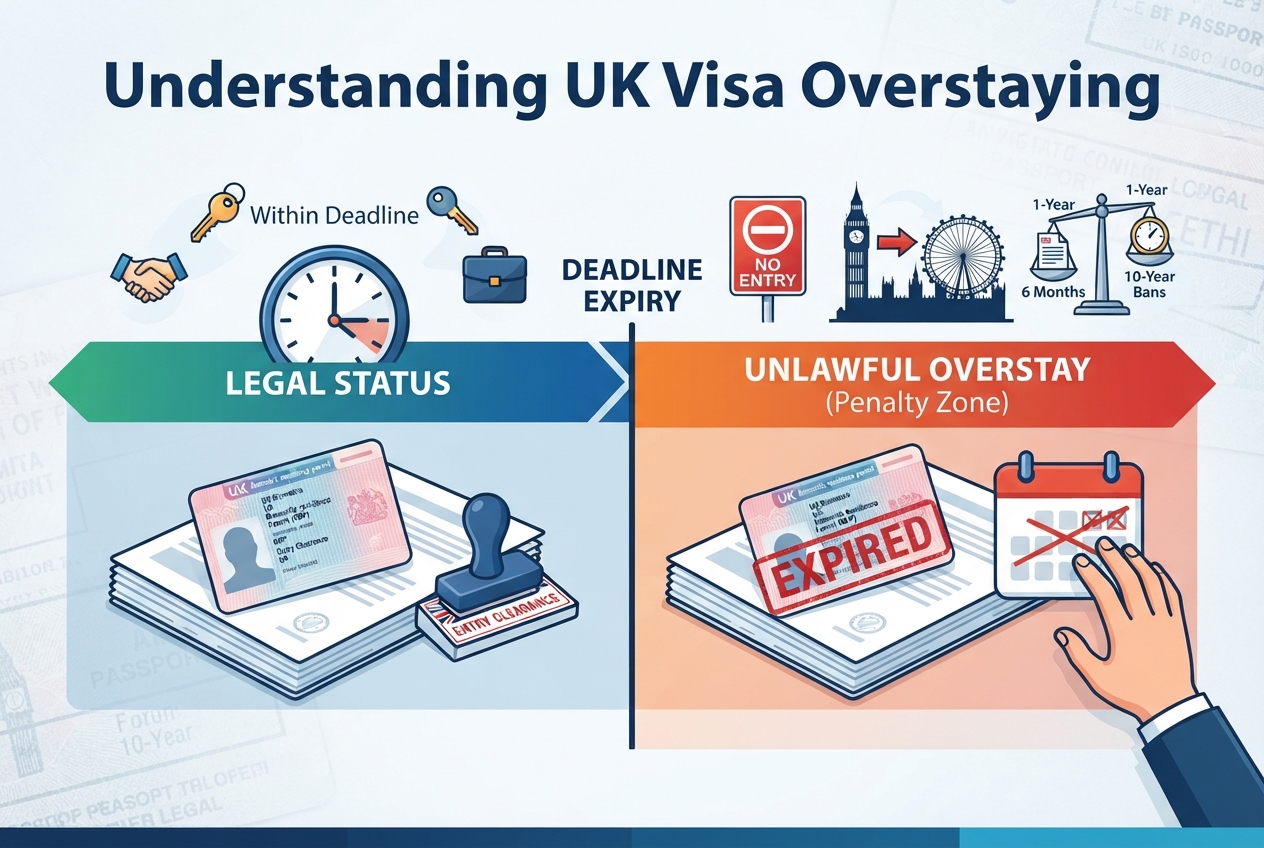
Navigating UK immigration law is often a high-stakes race against the clock. When a visa application is refused or a current visa expires, a precise countdown begins. Failing to act before specific legal deadlines pass transforms an individual from a lawful temporary resident into an unlawful overstayer.
At Visaway Immigration, we believe clear information is your best defence. This comprehensive guide outlines exactly what happens when you miss your deadlines, how the "hostile environment" impacts daily life, and how a simple delay can escalate into a mandatory 10-year ban from returning to the United Kingdom.
1. The Trigger: How Overstaying Begins
An individual becomes an unlawful overstayer in the UK through one of two primary events:
- Direct Visa Expiry: A current visa reaches its end date, and the holder does not submit a valid extension or switch to a new visa category before midnight on that date.
- Application Refusal & Loss of Section 3C Leave: If an applicant submits a valid, "in-time" visa application before their old visa expires, their legal status is safely protected under Section 3C of the Immigration Act 1971 while they wait for a decision. However, if the Home Office refuses that application, Section 3C leave automatically expires exactly 14 calendar days after the decision is received—unless a valid Administrative Review (AR) or appeal is lodged within that window.
2. Immediate Consequences: The Domestic Sanctions
The moment Section 3C leave ends, an individual is legally classified as an overstayer. The UK government enforces a strict "hostile environment" policy designed to deny access to infrastructure and essential services:
- Loss of the Right to Work: It becomes a criminal offence to continue employment. The Home Office updates its online checking service immediately, and employers face severe statutory fines if they do not terminate the individual's work.
- Loss of the Right to Rent: Private landlords are legally required to carry out "Right to Rent" checks. Overstayers cannot legally enter into a new tenancy agreement or renew an existing one.
- Banking and Licensing Restrictions: The Home Office routinely instructs UK banks to freeze or close accounts held by unlawful residents. The Driver and Vehicle Licensing Agency (DVLA) will also formally revoke the individual's UK driving licence.
- NHS Healthcare Charges: Free secondary healthcare access via the NHS is withdrawn. Overstayers are billed at 150% of the standard cost for medical treatment. Any outstanding NHS debt of £500 or more will result in automatic refusal of future UK visa applications.
3. The 14-Day Window: The Final Safety Net
Under Paragraph SUI 13.1 (historically known as Paragraph 39E) of the UK Immigration Rules, the Home Office provides a very tight, final window to fix an immigration status:
- The Refusal Concession: If a new visa application is submitted within 14 days of an application refusal (or within 14 days of an Administrative Review being decided, rejected, or withdrawn), the Home Office will disregard the brief period of overstaying and evaluate the new application on its merits. This is an automatic concession.
- The "Good Reason" Rule: If someone applies within 14 days of their original visa expiry (without a pending refusal), it is not automatic. They must submit concrete, documented evidence proving a compelling factor entirely beyond their control prevented an on-time application.
4. What Qualifies as a "Good Reason" for a Delay?
According to official Home Office caseworker guidance, a "good reason" must be an unforeseen, unavoidable, and serious obstacle that physically or practically prevented you from submitting an application or review on time. Caseworkers assess these on a case-by-case basis, and they must be backed by clear, objective evidence.
Examples of Accepted "Good Reasons":
- Serious Illness or Medical Emergency: Emergency hospitalisation or a sudden, debilitating physical or mental illness that rendered you incapable of making an application. Evidence required: A formal letter or medical certificate from an NHS consultant or GP confirming the dates and severity of the condition.
- Close Family Bereavement: The death or critical illness of an immediate family member (such as a partner, child, or parent) coinciding directly with the visa deadline. Evidence required: A certified copy of the death certificate or emergency hospital admission records.
- Severe Technical Glitches: An documented failure of the official Home Office online application portal or payment system on the day of expiry. Evidence required: Technical support tickets, email receipts from IT helpdesks, and screenshots displaying the error messages and timestamps.
- Extreme Criminal Victimisation or Fraud: Being subjected to a severe crime, such as human trafficking, coercive control, or falling victim to a criminal fraud scheme where an unregulated or untraceable advisor completely severed contact and withheld access to your legal records. Evidence required: A formal police report, an Action Fraud receipt, and a Crime Reference Number (CRN).
- Postal/Courier Delays: A verified, unexpected delay in the delivery of vital documents (like a passport or biometric card) entirely caused by a courier service or postal strike. Evidence required: Tracking numbers, official transit logs, and correspondence from the delivery network confirming the failure.
What Does NOT Qualify as a "Good Reason"?
- Forgetfulness or Oversight: Simply forgetting the visa expiry date or miscalculating the 14-day window.
- Financial Constraints: Not having enough money to pay the Home Office visa fee or the Immigration Health Surcharge (IHS) on the deadline date.
- Standard Advisor Negligence: Standard delays caused by your chosen solicitor or legal representative being slow, busy, or unhelpful (unless it escalates to criminal fraud with a police report). The Home Office views the applicant as ultimately responsible for their own submission timeline.
If an application is submitted more than 14 days late, or if your reason for a delay under 14 days is rejected, the Home Office has no legal mechanism to overlook it. The application will be refused automatically on suitability grounds.
5. The Ultimate Penalty: Mandatory Re-Entry Bans
If an overstayer fails to regularize their status or leaves the country past the allowed periods, they will face mandatory re-entry bans under Appendix Suitability: False Representation and Overstaying. These bans legally prevent the individual from returning to the UK for a set number of years.
The penalty depends entirely on how and when the individual leaves the UK:
|
Departure Circumstances
|
Length of Mandatory Re-Entry Ban
|
|
Voluntary departure at the applicant's own expense within 30 calendar days of visa expiry or refusal.
|
No Ban (The overstaying is recorded on your permanent file, but no mandatory ban applies).
|
|
Voluntary departure at the applicant's own expense more than 30 calendar days after visa expiry or refusal.
|
1-Year Ban from returning to the UK.
|
|
Voluntary departure funded directly or indirectly by the Home Office (at public expense), departing within 6 months of being notified of removal.
|
2-Year Ban from returning to the UK.
|
|
Voluntary departure funded by the Home Office (at public expense), departing more than 6 months after being notified of removal.
|
5-Year Ban from returning to the UK.
|
|
Formal Deportation or Administrative Removal executed by UK Immigration Enforcement officers.
|
10-Year Ban from returning to the UK.
|
Professional Guidance
In UK immigration, hours matter. A single missed deadline or an administrative error can disrupt your life, cancel your career, and trigger a decade-long exile from the country. If you have received a visa refusal or your visa is about to expire, you must act decisively within the statutory timelines to protect your future.
Disclaimer: This blog post is for general informational purposes only and does not constitute formal legal advice. Immigration laws change frequently. For advice tailored to your personal situation, please contact a regulated legal professional.